Author: Curry, Shenchao TechFlow
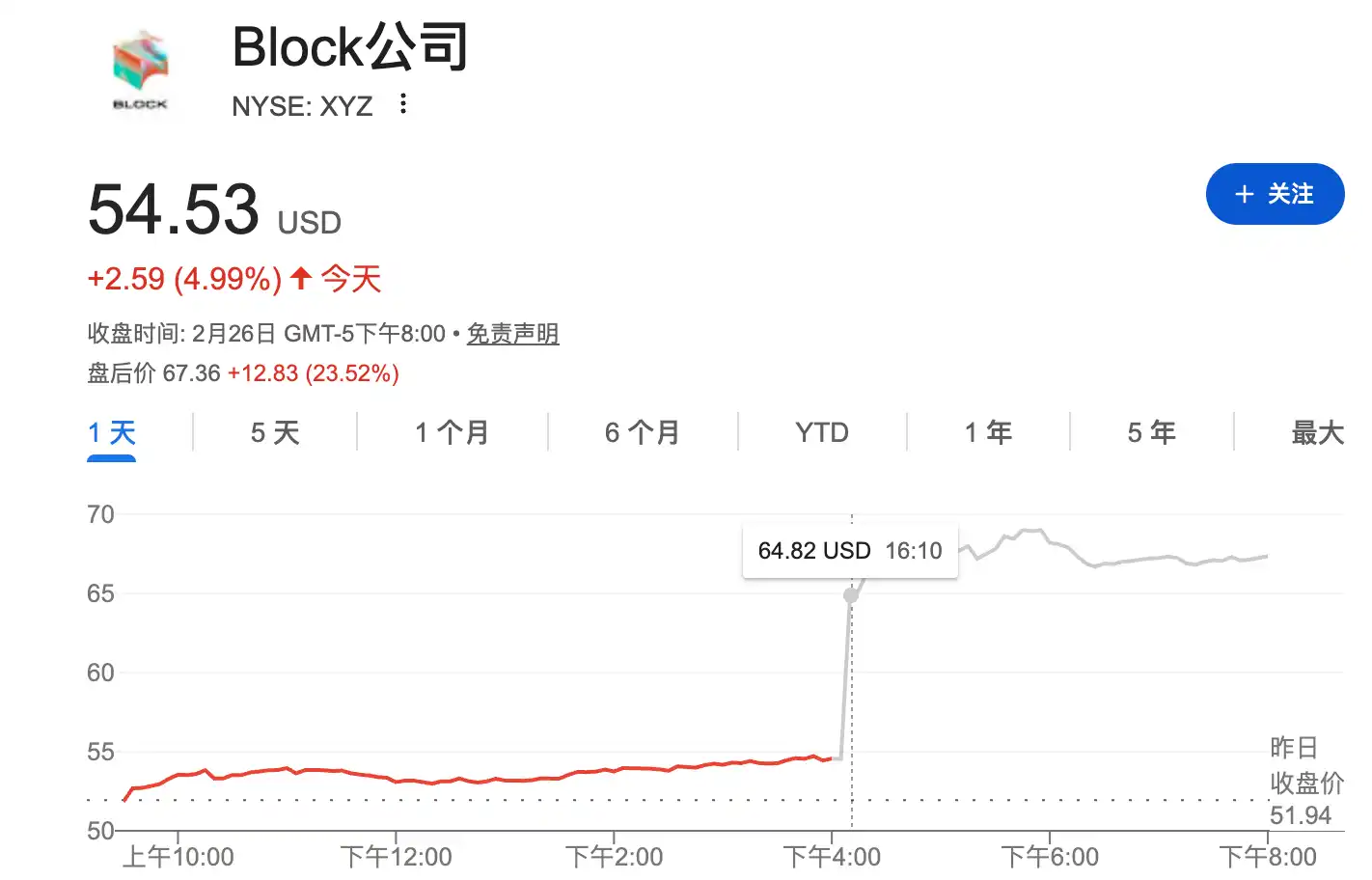
Last night after the U.S. stock market closed, a company called Block saw its stock price surge by 25%.
Not because of a new product launch, not because of landing a major client. It was because the CEO announced layoffs of nearly half the employees.
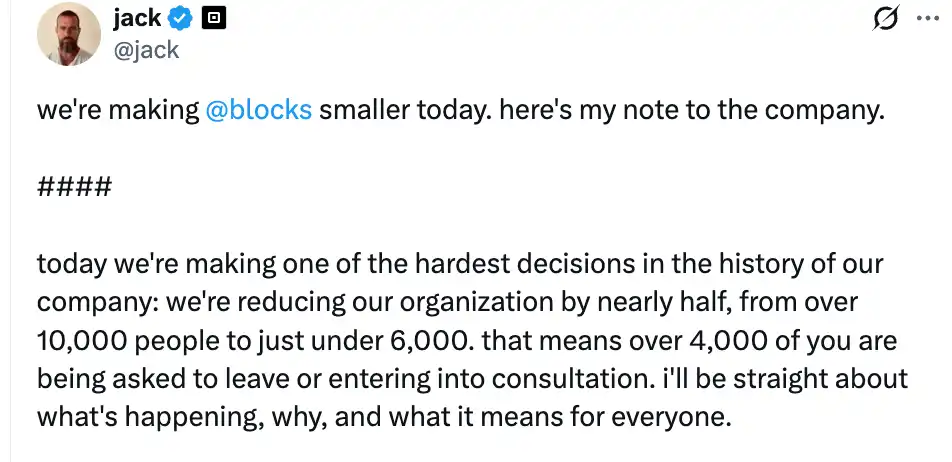
From over 10,000 people, cut to less than 6,000. Over 4,000 people are leaving.
Once the news broke, investors voted with their real money. The closing price was $54, and after hours it shot up to $67. In one night, Block's market cap increased by nearly $3 billion.
Lay off 4,000 people, gain $3 billion in market cap.
Calculated this way, each person laid off is worth $750,000.
Many might not have heard the name Block, but you've likely seen its products.
Square, that little white square card reader on American streets, used by small merchants for payments. Cash App, used by American youth for transfers, somewhat like a U.S. version of Alipay.
The company's full-year 2025 revenue was $24.2 billion, with gross profit exceeding $10 billion. It's a fintech giant listed on Nasdaq.
Its CEO is Jack Dorsey. You might not have heard this name either, but you definitely know another thing he did—he is the co-founder of Twitter. Founded Twitter in 2006, served as CEO twice, resigned in 2021.
A year later, his friend Musk bought Twitter and renamed it X.
Now, Dorsey focuses all his energy on Block. He is also a Bitcoin maximalist; Block holds Bitcoin on its balance sheet, and the company also invests in Bitcoin mining and self-custody tools.
When it comes to layoffs, most CEOs use the same rhetoric.
Strategic adjustment, organizational optimization, focusing on core business. Translated into plain language: you're fired, but I don't want to say it too harshly.
Dorsey didn't do that.
In his letter to shareholders, he wrote directly: intelligence tools have changed the way we build and operate a company. A smaller team, using the tools we are building, can achieve more, and do it better. And the capabilities of these tools are getting stronger every week.
Translation: AI can do your job, and it's getting better at it.
He didn't even use the word "AI," as if that makes it sound less harsh.
However, he added a post on X: he could have chosen to lay off slowly, a wave every few months, dragging it out over years. But he felt repeated layoffs destroy morale, so it's better to do it all at once.
"I would rather make a difficult but clear decision now, than slowly reduce headcount towards the same outcome."
This might be the first CEO in the AI boom who doesn't make any excuses for layoffs. Doesn't blame industry cycles, doesn't blame the macro environment, doesn't blame strategic mistakes. Just says it straight: the tools are better than people now.
It's hard to say he's not sincere. But this kind of sincerity is more uncomfortable than those platitudes.
We also checked the changes in employee numbers at Block.
Public data shows that at the end of 2019, Block had 3,835 people in total. Then the pandemic hit, online payments exploded, Cash App users surged, and the company started hiring frantically. By the end of 2025, 10,205 people.
In six years, it nearly tripled.
Now cut back to 6,000.
That is to say, the over six thousand people hired during the pandemic, after working for a few years, are now uniformly categorized as "replaceable by intelligence tools."
Block is not an isolated case. During the pandemic years, almost all tech companies were scrambling for talent. Meta doubled its employees in two years, then went through three rounds of layoffs starting in 2022. Amazon and Google have experienced similar expansion and contraction.
But this time Block is different. Other companies found other reasons for layoffs; Dorsey directly pinned the cause on AI.
There's another sentence in his public letter:
I don't think we're doing this too early; I think most companies are doing it too late. Within a year, most companies will reach the same conclusion and make similar adjustments.
And his approach reminds one of a person.
In October 2022, Musk spent $44 billion to buy Twitter and laid off about 3,700 people in the first week, roughly half the employees.
At the time, the whole Silicon Valley thought he was crazy. Advertisers fled, systems crashed frequently, public opinion overwhelmingly criticized him. Twitter's valuation shrank from $44 billion to less than $20 billion under his watch.
Dorsey watched it all happen. He is not only the co-founder of Twitter, he also publicly supported Musk's acquisition. The two have a good relationship.
Three years later, Dorsey did almost the exact same thing at his own company.
Cut nearly half the people, done in one go, no messing around. Even the management tactics are copied:
Musk demanded federal employees at DOGE send weekly emails reporting five major achievements; Dorsey requires Block employees to send him weekly emails listing five work achievements.
Then, he uses AI to summarize these emails.
The difference lies in the outcome. After Musk cut Twitter, the market thought he was destroying it. After Dorsey cut Block, the market thinks he's leading the future. The same action, one lost over $20 billion in valuation, one gained $3 billion in market cap.
What's the difference?
Dorsey did two more things. First, he paired it with a very good earnings report: Q4 gross profit grew 24%, Cash App gross profit rose 33%, 2026 profit guidance exceeded analyst expectations. Second, he gave the layoffs the most useful narrative of this era:
Not layoffs, but AI transformation.
Actually, weeks before last night's cuts, things had already been chaotic inside Block.
In early February this year, the company did a round first, cutting about 10% of positions, roughly 1,100 jobs. At the same time, Dorsey issued an order: all employees must use AI tools in their daily work.
According to Wired, some employees expressed dissatisfaction: "If these tools were really useful, we would have used them already."
Then came the weekly email system. Everyone sends Dorsey a weekly email listing their recent five work achievements. Dorsey uses AI to summarize these emails.
Think about this process: you are required to prove your value to the CEO weekly, and the CEO doesn't even read what you wrote himself.
Also according to Wired, at an all-hands meeting, an employee said directly: "This is the lowest morale moment in my four years here, the entire company culture is collapsing." Others said they didn't know if they would have a job next week, making it impossible to plan anything in life.
Dorsey's response at the meeting was: some of you have been slacking off.
On one side, employees saying they don't know if they'll be here tomorrow; on the other, the CEO saying some of you have been slacking off. This conversation happened in the same meeting room.
Block is not the first, and won't be the last.
Shopify's CEO told employees this year that if you want to request more headcount, first prove AI can't do the job. Klarna's CEO publicly celebrated AI replacing 700 customer service positions. An internal Amazon memo said the company needs "fewer layers" because AI is "the most transformative technology since the internet"...
But these companies somewhat遮掩 (cover it up), packaging AI layoffs as "efficiency improvement," "organizational upgrade." Dorsey is the first to completely pierce the window paper, just saying AI can do your job, and the capital market rewarded him with a 25% stock increase.
This is the most terrifying part.
CEOs now know: publicly saying "I replaced half the people with AI" won't be punished; instead, it will be rewarded.
Finally, after reading Dorsey's shareholder letter and his full post on X last night, I had a feeling: this person really isn't lying.
The company's performance is good; he didn't pretend to be struggling. The reason for layoffs is AI; he didn't make other excuses. The severance package offers 20 weeks' salary plus one week for each year of service, plus 6 months of health insurance and a $5,000 relocation allowance,确实比很多公司体面 (indeed more decent than many companies).
He even specifically arranged a video直播 (live stream) to personally thank the laid-off people. He himself said doing this might seem awkward.
We have reason to believe he is sincere.
But sincerity doesn't change anything. 4,000 people will wake up tomorrow still without jobs, while Dorsey will wake up to a more valuable company.
There is one detail here worth every worker's attention.
Those laid-off employees at Block, in the past few weeks, were required to use AI daily, required to write weekly emails to the CEO proving their value. They complied. And then probably got laid off anyway.
That is to say, knowing how to use AI won't keep you safe, proving your value won't either. When the company decides to do the same work with fewer people, your efforts only make this conclusion come sooner.
Dorsey says most companies will do the same within a year.
I don't know if he's right, but one thing is certain:
When your boss starts seriously studying how many people AI can replace, you'd better also seriously think about whether your income source is only this one salary.